| Photonic Switching Using
Light Bullets
Technology Overview
What is it?
- An all-optical switching design made
of highly nonlinear materials. The technology uses light bullets
to perform ultra-fast, all-optical switching in solid-state
devices.
- The technology works in a simulated environment
and has been independently validated, but has not been proven
in a physical environment.
Why is it special?
- Exploits a unique property of light that allows
for light pulses to be directed by other light pulses.
- Offers many compelling advantages that
make it a potentially disruptive technology:
- Non-mechanical method to alter the path of light pulses
will provide faster speed, prevent pulse degeneration, enhance
stability and reliability, require less energy, and extend
component life.
- Uses readily available, inexpensive materials including
highly non-linear optical glasses, semiconductor crystals,
and/or multiple quantum well semiconductor materials.
- May be applied across a broad range of potential
applications.
- Technology is protected by two patents (issued
to the U.S. Government in 1997 and 1999). Cyrospace has exclusive
license to both patents.
- As the technology is proven and further developed,
we expect further IP to be created and patented.
Objective
Cyrospace has initiated the
effort to commercialize a patented invention, which describes
devices using light bullets to perform ultra-fast, all-optical
switching. This technology enables all-optical switching in
a solid state device, such as a planar slab wave-guide made
of highly nonlinear optical materials including highly non-linear
glasses, semiconductor crystals, and/or multiple quantum well
semiconductor materials. It uses optical pulses in the planar
wave-guide, and these pulses are stable and self-supporting
due to nonlinear effects that balance the effects of dispersion
and diffraction, i.e. these pulses are light bullets. Major
advantages are the potential for massive parallelism (in space)
and pipelining (in time).
Technology Profile
The rapid proliferation of information
technology in commerce, finance, education, health, government,
security, and entertainment, together with the ever-increasing
power of computers and data storage devices, is beginning to
fuel a potentially massive demand for network interconnection,
especially broadband services. Switching is an essential operation
of all communications networks and digital computers and signal
processing systems. Switching is presently a limiting factor
in the speed of operation of optical communications and computing
as most commercial devices must use either electrical, acoustic,
or magnetic forms of switching. Switching using asynchronous
transfer mode (ATM) is expected to meet the short-term demand,
but in the longer term electronic systems will become increasingly
complex and costly. Network designers will turn increasingly
to photonic transport and switching technologies. An all-optical
switch would have the inherent advantages of higher speed and
higher efficiency.
Cyrospace and NASA researchers have performed
computer simulations and developed designs for an all-optical
switch made of highly nonlinear materials in which light bullets
propagate through, and interact nonlinearly with each other
within a planar slab waveguide to selectively change each others
directions of propagation into predetermined output channels.
The resulting performance should enable low power, high speed
(100 femtosecond light bullets) switching in a small device,
easily manufactured using current semiconductor manufacturing
techniques.
Benefits
* Faster speed of operation
* No pulse degeneration
* Requires less energy
* Potential for massive parallelism (in space) and pipelining
(in time)
* High reliability; solid state device with no moving parts
* Uses commercially available materials
Potential Application
| Application |
Strategic Fit |
| OXC – Alternative to MEMS |
• Light bullets have direction changing capability
at relatively high switching speed and very low dispersion.
This technology offers many advantages over existing competing
technologies |
| Optical Packet Switching |
• Switching in time domain at Pico-=second pulse
lengths |
| Optical Storage / Processing |
• Speed of optical bullets can create virtual storage
kind of environment |
| Optical Sensors |
• Degree of overlap of the two pulses impacts the
degree of deflection, in principle it should be possible
to create a very sensitive device to measure a change in
position (e.g., may be accelerometers?) |
| DWDM |
• Light bullets have “Fusion / Fission”
capabilities that would enable multiplexing / de-multiplexing |
| OIC (optical integrated chip) |
• Consolidate the various soliton based optical
components on a single chip |
Others
- OADM
- NLOA
- Modulation scheme
- Encryption
|
• Modulation scheme that provides a high level of
data compression with no-loss of data (ie, no approximation
algorithms)
• A way to apply the technology to
provide very strong encryption without large payload overhead
|
Technical Basics
There are a number of all-optical switching devices,
including some that use solitons. A special form of solitons,
called light bullets, are essentially pulses of light which,
when propagating in a non-linear medium, maintain their shape
and are self-guided due to the balance of diffraction, the mediums
group velocity dispersion, and nonlinear self-phase modulation.
To date light bullets have been studied only theoretically,
and some disagreement exists over the conditions, which are
necessary for them to exist and function.
Computer simulations has been performed using
the exact Maxwell’s equations without any approximation,
and have shown that light bullets are in fact stable and that
there is no need for saturation of the material to obtain stability.
The necessary material parameters including negative group velocity
dispersion, high non-linear index of refraction, and wavelength
of light in order for the light bullets to interact and selectively
change each others direction of propagation have been described
in this invention.
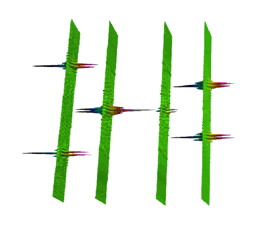
The figure below shows the results of the
computer simulation of two colliding light bullets that deflect
each other through attraction. The figure plots the electric
field at four different times. At the first instant of time,
it shows the two pulses approaching, Then they are interfering
destructively, (and the energy is now contained in the magnetic
field, which is not shown, but which is also calculated). Next
they are interfering constructively, and finally they are departing.
Notice that they have regained their initial shapes. They have
also deflected each other, although from the viewpoint of the
figure, the deflection is not noticeable. An overhead viewpoint
shows that after the collision, at the time of the fourth instant
shown in the figure, the left moving pulse has been deflected
down a distance about equal to the pulse width and the right
moving pulse has been deflected up an equal distance. This deflection
is the basis of the light switch, where light switches light.
Notice also that the optical cycles are displayed in each pulse.
This method of calculation resolves the motion of the optical
carrier in each pulse so that the phase velocity of the optical
carrier, as well as the group velocity of the pulse can be observed.
Based upon these simulations,
our researchers have described all-optical switching devices
using light bullets in planar slab waveguides made from commercially
available nonlinear glasses and semiconductor materials. Propagating
light bullets interact in such a way that they are deflected
in different output channels from the waveguide thus constituting
an all-optical switch. The multiple quantum well semiconductors
are of particular interest as they require far lower powers
(below 1 Watt) of light intensity in order to support light
bullet propagation.
Technology Superiority
Current
Technologies |
Key
Metrics |
MEMS |
Liquid
Crystal |
Thermo-optics |
Bubbles |
Soliton
/ Light Bullets |
| Scalability
|
High
(1k x 1k)
|
Medium
(unknown)
|
Low
(16 x 16)
|
Medium
(32X32)
|
Low
(unknown)
|
Switching speed |
Low
(>20ms)
|
Low
(T sensitive)
|
Medium
(6ms, silica)
|
Medium
(10ms)
|
HIGH
(10-18 s)
|
Reliability |
Medium
(Moving parts)
|
Good
(No Moving parts)
|
Medium
(Moving parts)
|
Good
(No Moving parts)
|
High
(No Moving parts)
|
Losses |
High
(>7dB)
|
Medium
(path length)
|
Low |
Medium
(4.5dB)
|
Low |
Power usage |
High
(< O-E-O)
|
Low
(T sensitive,
Inverse speed)
|
High (silica)
Low (Polymer)
|
High |
Low |
Temperature
sensitivity |
High |
High |
High |
High |
Low |
Cyrospace perceives that the subject
technology will power much of the worldwide technological and
economic advancement that will occur over the next twenty-five
years. This technology will form the basic components of the
future photonic processing devices. Photonic computation could
lead to computational devices hundreds of times smaller and
faster than the smallest devices possible with semiconductor
or molecular electronics. This enormous shrinkage potential
and increase in speed should lead to an industry that overshadows
the semiconductor industry that is in place today.
Contact
If your company is interested in investing or participating
in the research and development of this technology, please contact
us at info@cyrospace.com.
|